
Vegetation Segmentation
Vegetation intruding into the clearance gauge of railway tracks, for instance after heavy rainfall or seasonal growth, can lead to safety hazards, signal obstructions, and maintenance challenges.
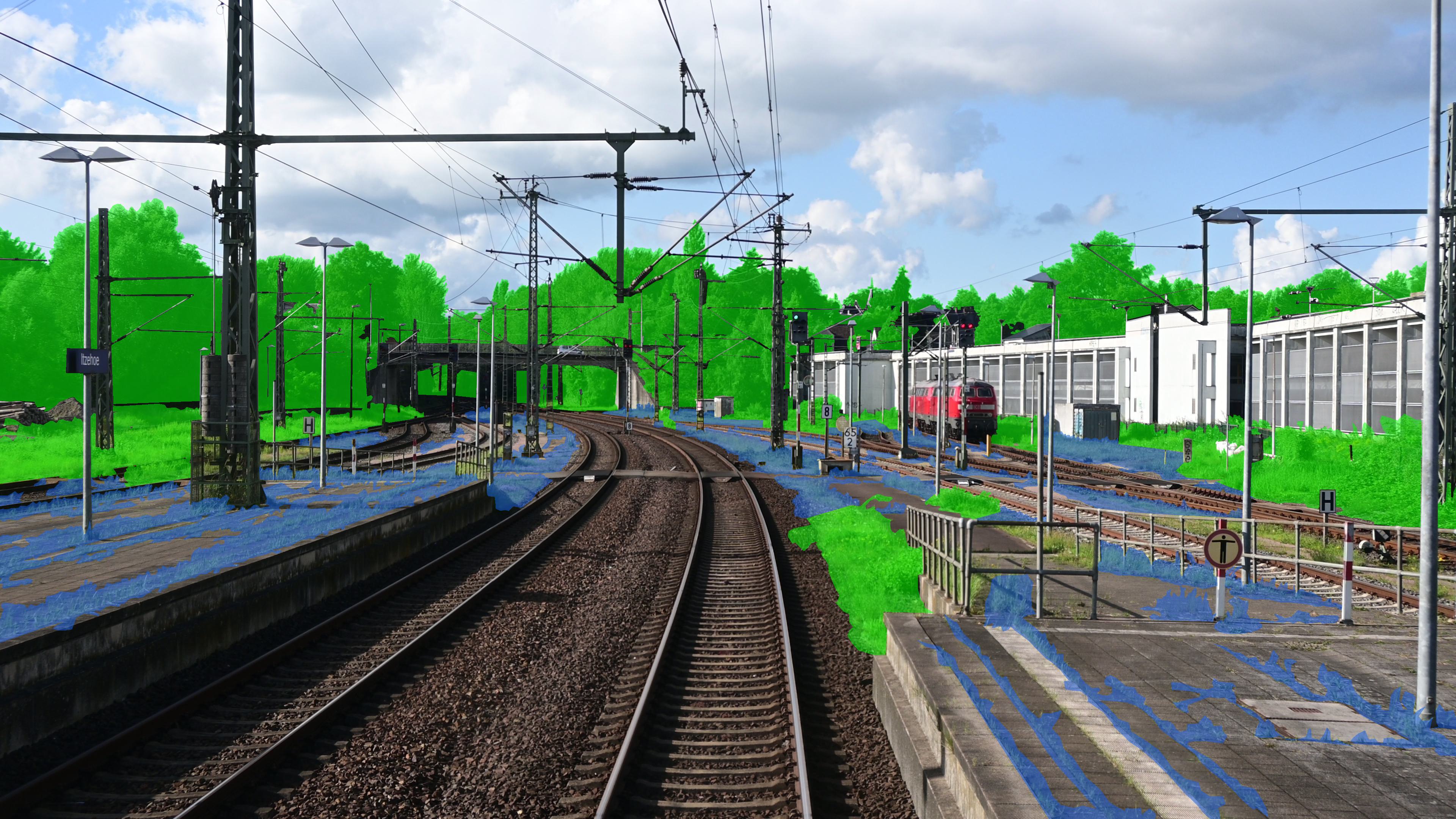
The RAIL-BENCH Vegetation Segmentation benchmark provides pixel-level annotations of vegetation in railway scenes, differentiating between low and high-growing vegetation.
Dataset
The RAIL-BENCH Vegetation dataset comprises 740 real-world RGB images, split into 520 training, 110 validation, and 110 test images. Vegetation is annotated at the pixel level differentiating between low and high-growing vegetation. The entire dataset — with exception of the test ground truth — is publicly available for download:
Annotation Policy
-
We define two vegetation classes:
low-growing vegetation (vegetation up to roughly 20 cm) and high-growing vegetation (vegetation over 20 cm). - Vegetation observed through fences or lattice catenary poles are not annotated.
RAIL-BENCH Vegetation Challenge
In the RAIL-BENCH Vegetation challenge, predictions on the held-out test set are evaluated using mean Intersection over Union (mIoU) averaged over both vegetation classes and the background class following standard semantic segmentation evaluation protocols.
How to Participate
- Download the RAIL-BENCH Vegetation dataset and check the documentation of the CodaBench Vegetation Segmentation challenge.
- Train your model with the train split of the dataset. Do not use the validation split for training, but only for hyperparameter tuning, early stopping, etc. You can use additional training data from other sources, but should state that when submitting your results.
- Optionally: use the RAIL-BENCH toolkit to compute evaluation scores on the validation set locally.
- Recommended: use the RAIL-BENCH toolkit to check whether you correctly formatted your predictions.
- Go to the CodaBench Vegetation Segmentation challenge, to submit your predictions and get evaluated on the hidden test set.