Frequency Adaptive Neural SLAM
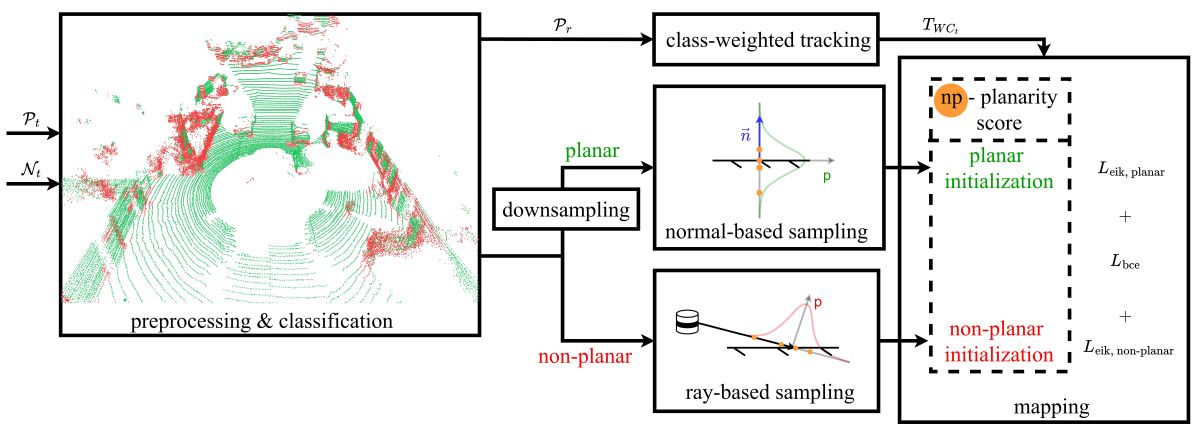
Neural implicit maps are a memory-efficient way to represent 3D environments for LiDAR SLAM, encoding surfaces with small neural networks instead of storing raw points. A known weakness of these networks is that they learn smooth, low-frequency surfaces such as walls and buildings much faster than complex, high-frequency structures like vegetation. We address this weakness by classifying incoming LiDAR points as planar or non-planar and treating the two classes differently throughout the SLAM pipeline: separate decoders learn each surface type independently, and the map training pipeline is adapted to the different surface types by focusing training on non-planar regions and generating more precise training labels for planar regions. Evaluated on the KITTI dataset, our approach reduces average translational error by 6% compared to the state-of-the-art PIN-SLAM and, notably, eliminates the localization failures caused by unfortunate random sampling of the training pool.