Self-/Semi-Supervised Online HD Map Perception
Online HD map construction models predict a vectorized map of the local surrounding in real time, reducing the dependence on costly offline HD maps. However, training these models requires large amounts of annotated map data, and providing such labels remains the major bottleneck for scalable online HD map construction. Self- and semi-supervised learning offers a way out: by combining a small labeled dataset with a large body of unlabeled driving data, model performance can be boosted without additional annotation effort.
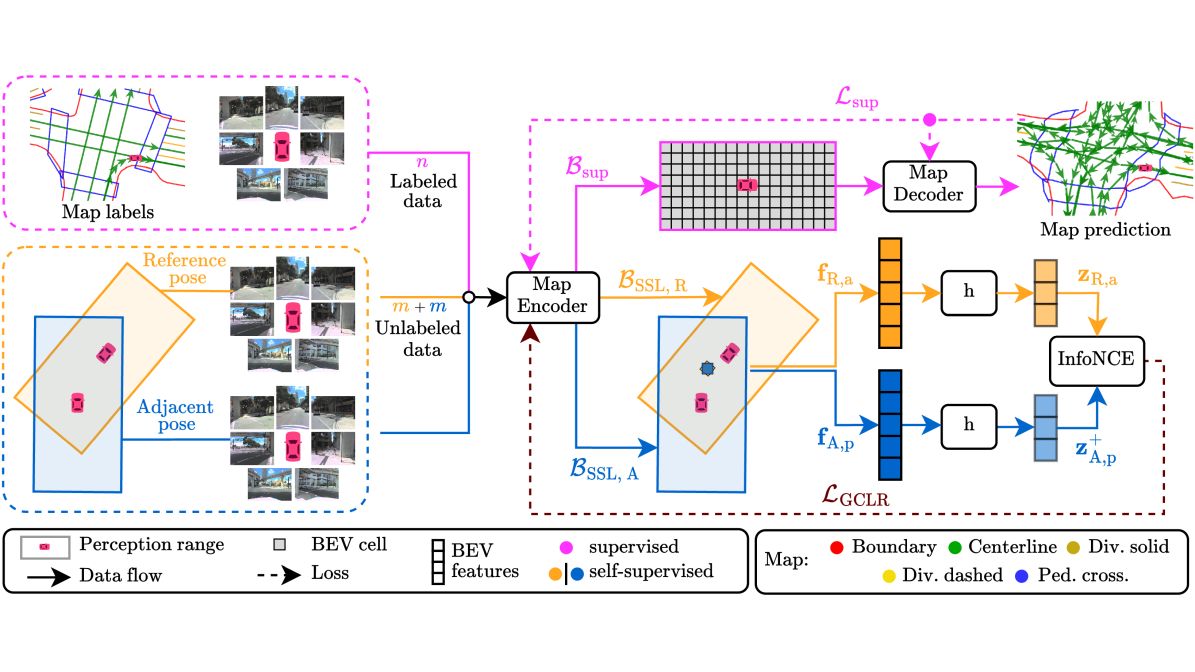
A key insight is that driving data itself provides rich supervisory signals. When the same area is traversed multiple times, the perceived environment should remain spatially consistent across traversals; likewise, consecutive observations within a single drive should be temporally consistent. We research methods that exploit these consistency cues as self-supervised training objectives — for example, contrastive learning between geospatially overlapping birds-eye-view (BEV) representations — enabling the model to learn meaningful map features from unlabeled data.
In addition, we investigate semi-supervised training strategies such as teacher-student architectures, where a model trained on limited labels guides the learning on unlabeled data. Our goal is a label-efficient training paradigm that makes online HD map perception scalable even when annotated data is scarce.
Publications
J. Merkert, A. Blumberg, J.-H. Pauls, and C. Stiller, MapGCLR: Geospatial Contrastive Learning of Representations for Online Vectorized HD Map Construction. arXiv preprint arXiv:2603.10688, 2026.